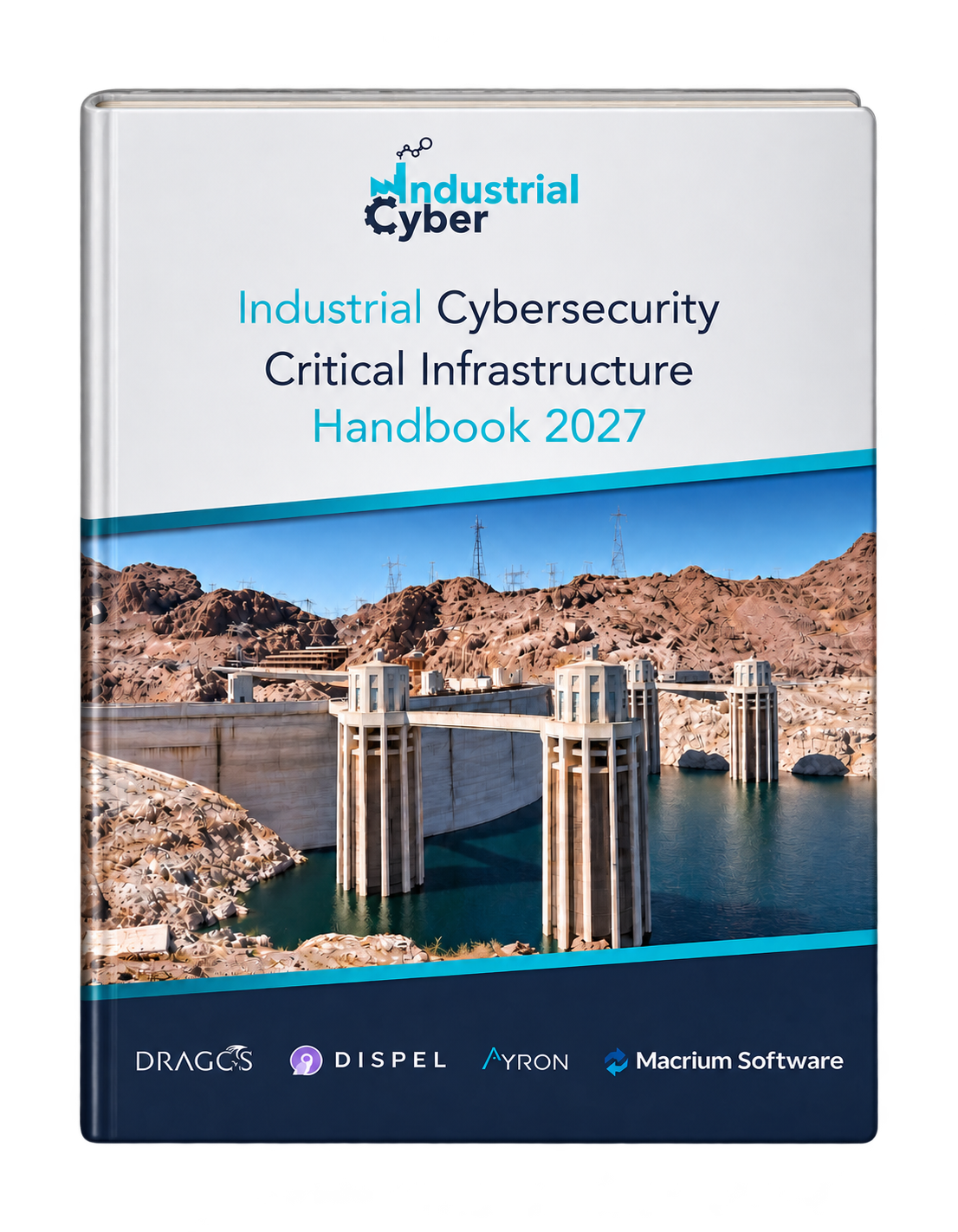
Industrial Cybersecurity Critical Infrastructure Handbook 2027
Why this handbook matters
Critical infrastructure operators face a unique challenge: protecting essential systems and services that cannot simply stop.
The Industrial Cybersecurity Critical Infrastructure Handbook 2027 brings together expert perspectives on the challenges shaping OT cybersecurity, from evolving threats and regulatory obligations to operational continuity, incident response, and recovery readiness.
Drawing on Industrial Cyber Days: Critical Infrastructure 2026, the handbook features insights from practitioners across power, water, energy, manufacturing, and other critical sectors.
Macrium Software contributes a dedicated chapter: “Backed Up, But Can You Recover?”
Protecting critical infrastructure means protecting operational continuity
For critical infrastructure operators, a cyber incident is more than a security event. It can disrupt essential services, compromise safety, and affect communities and businesses far beyond the systems directly involved.
The handbook explores how organizations can strengthen operational resilience, including:
- Why cybersecurity decisions should focus on operational consequences, not just individual assets
- How accountability is shared between asset owners, operators, OEMs, and system integrators
- Why threat visibility must extend beyond traditional OT networks
- How regulatory requirements influence operational security decisions
- Why successful backups do not guarantee recovery
- How essential services can continue when systems are compromised and external assistance is unavailable
Featured chapter — Backed Up, But Can You Recover?
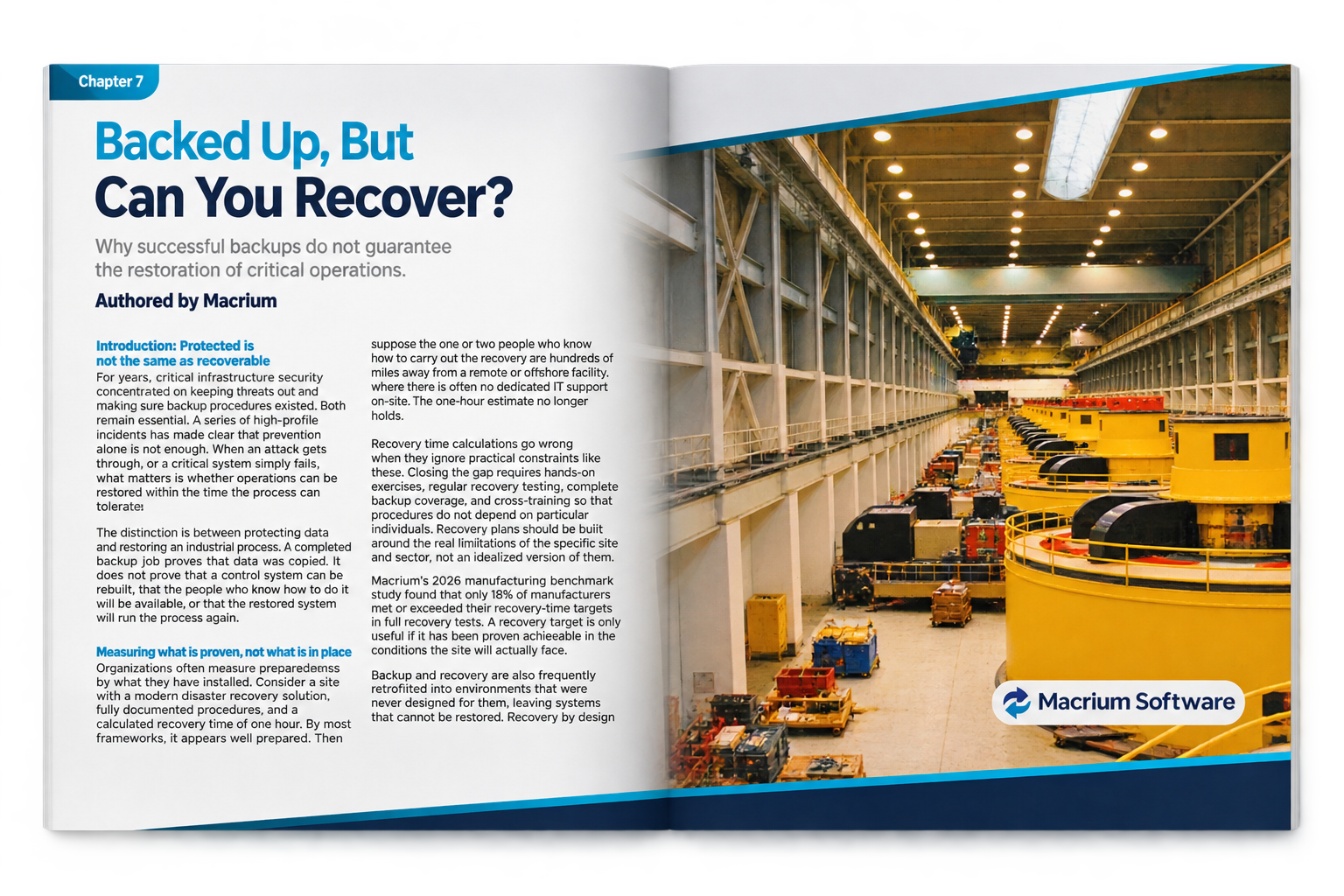
A successful backup does not mean a critical system can be restored within the time operations can tolerate.
Macrium's featured chapter examines the gap between backup completion and proven recovery capability, highlighting why critical infrastructure organizations must account for real-world recovery constraints.
From remote facilities without dedicated IT support to legacy systems, undocumented configurations, and dependencies on external specialists, recovery can be far more complicated than a documented plan suggests.
The chapter explores how organizations can build recovery into system design, extend protection beyond obvious assets, and validate restoration procedures before an incident occurs.
Protected is not the same as recoverable
A completed backup job confirms that data has been copied. It does not prove that critical operations can resume.
Recovery confidence depends on answering some difficult questions:
- Can critical systems be restored without relying on a single specialist?
- Are all essential configurations and dependencies protected?
- Can recovery proceed if networks or external services are unavailable?
- Are recovery procedures documented, current, and repeatable?
- Can legacy systems be restored when identical replacement hardware is unavailable?
- Have recovery times been validated under realistic operational conditions?
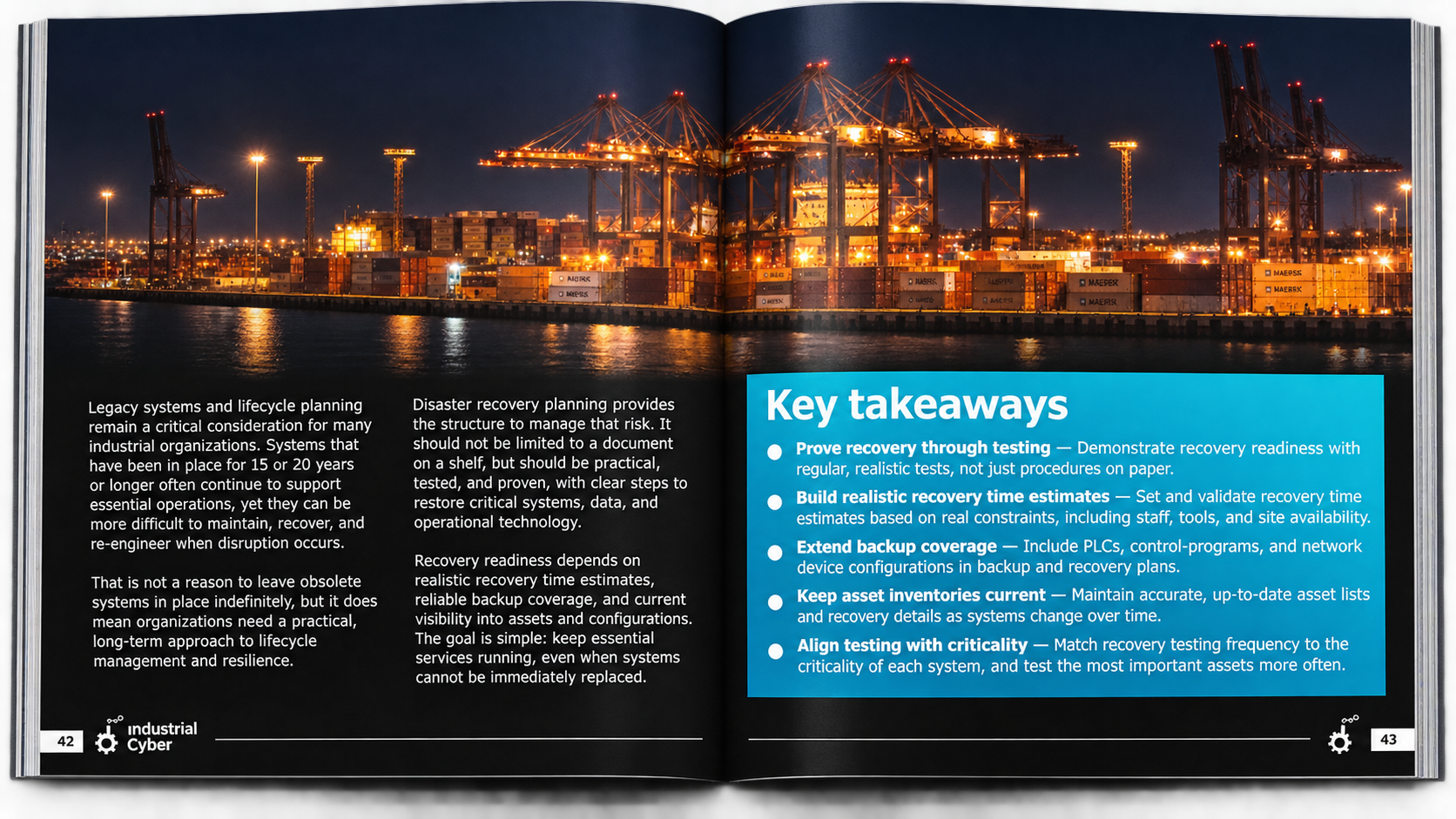
For critical infrastructure, recovery readiness must be demonstrated through testing, not assumed from the existence of backups.
Inside the handbook
A Download the handbook to explore:
Protect the Value, Not Just the Asset
Understand why cybersecurity priorities should be determined by the operational services and outcomes that systems support.
Who Actually Owns the Decision?
Explore how asset owners, operators, integrators, and service providers can establish clear accountability for cybersecurity decisions.
Threat Hunting Beyond the OT Boundary
Learn why effective threat visibility must extend to the connected systems and dependencies that influence operational processes.
When AI Enters the Control Loop
Examine the opportunities and risks associated with AI influencing industrial decisions, operational data, and critical processes.
Remote Access: Same Risk, Different Rulebooks
Understand the challenges of securing vendor and third-party access across electric and water utility environments.
When Regulation Meets Operational Reality
Explore how the Cyber Resilience Act and NIS2 influence the relationship between industrial equipment manufacturers and operators.
Backed Up, But Can You Recover?
Read Macrium's chapter on recovery validation, documentation, legacy systems, and restoring critical operations under real-world constraints.
Keeping Essential Services Running After Compromise
Discover why operators must prepare to maintain essential services when communications fail and outside assistance is delayed.
Recovery confidence for critical infrastructure
Critical infrastructure environments depend on systems that must remain available for years, often operating across remote, legacy, or disconnected locations.
Macrium helps organizations protect and recover Windows-based operational systems, including engineering workstations, HMIs, servers, and other critical Windows endpoints.
With image-based backup and recovery capabilities designed to support offline and air-gapped environments, Macrium helps teams reduce recovery uncertainty and restore systems to a known-good state.
Because in critical infrastructure, recovery is not simply about restoring IT. It is about supporting the continued delivery of essential services.



Featured by Industrial Cyber
Macrium Software is proud to contribute to the Industrial Cybersecurity Critical Infrastructure Handbook 2027 alongside other industrial cybersecurity specialists.
The handbook brings together practical perspectives to help security, engineering, and operational leaders strengthen resilience across essential infrastructure.

Download the Industrial Cybersecurity Critical Infrastructure Handbook 2027
Get the full handbook and read Macrium's featured chapter, “Backed Up, But Can You Recover?”, alongside expert insights into protecting critical infrastructure and maintaining operational continuity.